

_a9c1b4.png)
_49ee3f.png)

Paul
Administrators
-
Joined
-
Last visited
Everything posted by Paul
-
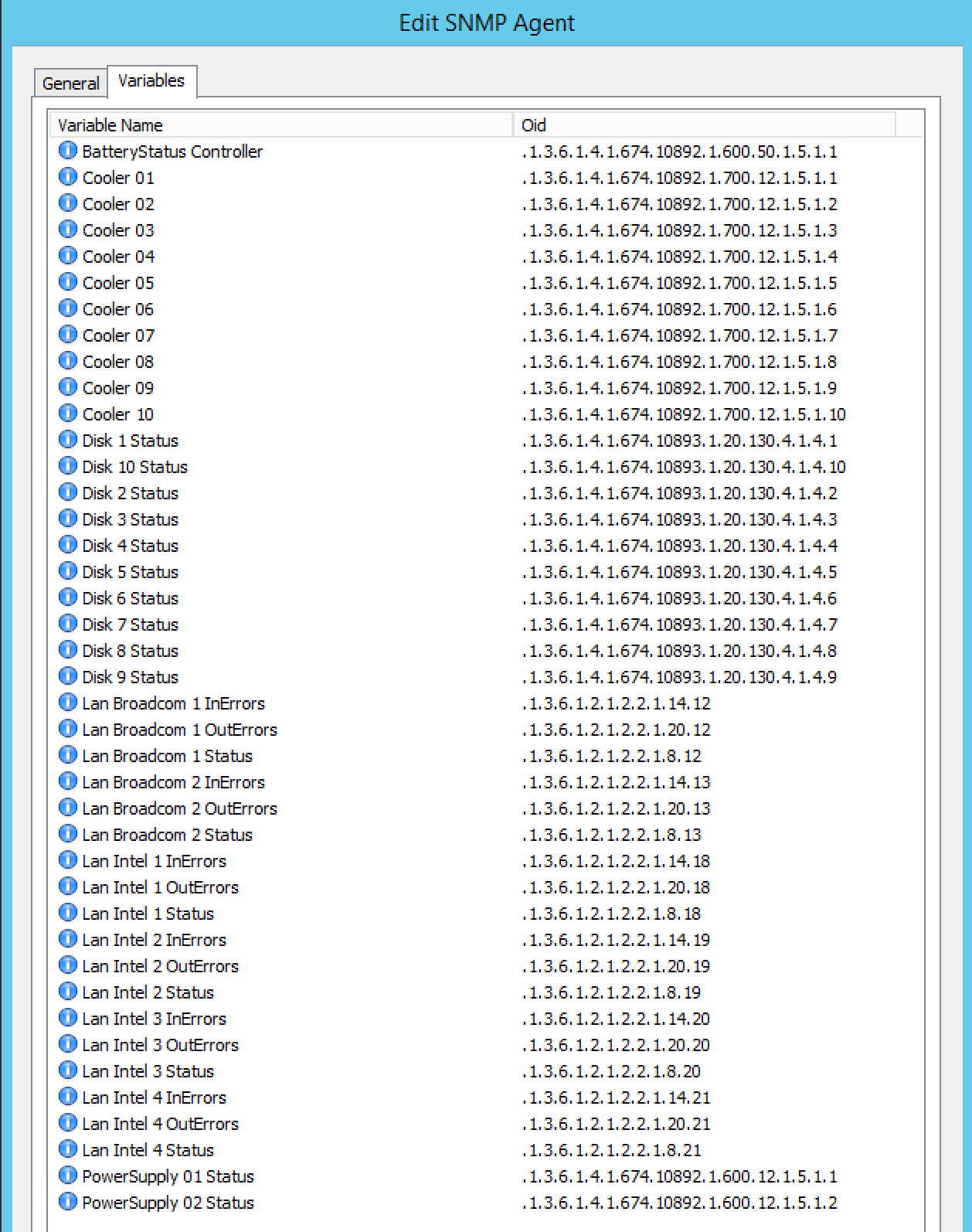
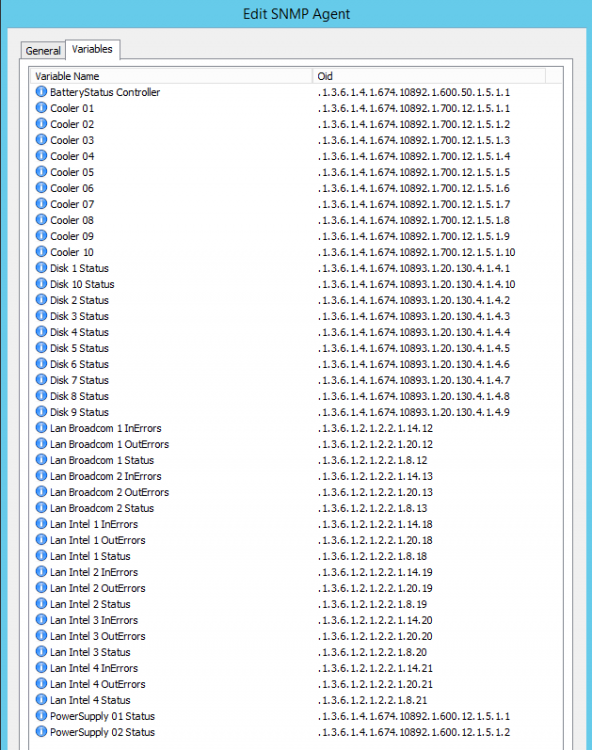
I recommend you to use SNMP for sensor monitoring. See the following screenshot for an example and google for the MIBs (mib1 and mib2). (Credits go to Luis for his extensive research in the DELL MIBs) -Paul
-
For RAID monitoring we've seen successful implementations through SNMP and Event Log. I could give some examples if you would tell me what RAID adapters you're using. -Paul
-
-
-
-
I absolutely love this. I'm using the Android app a lot and this would greatly improve my productivity. I'll notify the development team of this. -Paul
-
-
-
-
Hi Michel, It's part of our wish list but due to the very little popularity of the Linux agent compared with the immense amount of feedback we receive for the Windows agent this was pushed from the Roadmap. I've brought this up in a meeting today and we're trying on bringing it back on the Roadmap. I apologize for the inconvenience. In the meantime you can create a bash script that will use SNMPGET to query SNMP devices and if the value doesn't meet your criteria then return an exit code (exit [number]) that's not zero to mark the script as failed (which can send a notification if enabled). -Paul
-
I doubt that script 3 will execute. We don't continue a task execution after a reboot. If you need to schedule a reboot for your systems I recommend you to configure the Maintenance Schedule on your machines (can also be done via a Pulseway Group Policy). Powershell to control the maintenance mode: Set-ItemProperty -Path "HKLM:\Software\MMSOFT Design\PC Monitor" -Name "MaintenanceMode" -Value "1" -Paul
-
-
Hi Christian, Check out our case studies over here: https://www.pulseway.com/casestudies -Paul
-
Hi Christian, Are you referring the hardware monitoring (temperatures / remaining life) or to the free disk space monitoring? What is the manufacturer and model of your SSD? -Paul
-
Glad I could help . -Paul
-
Is the computer connected to a docking station? (we have a known issue with docking stations at this time) If not, enable the diagnostic logging from the Pulseway Manager app in the Settings -> Diagnostics tab, attempt the RD connection again and once you get the error post the output of the rd_agent.log from the Pulseway installation directory on the agent side. -Paul
-
I'm afraid there is no SNMP module on the Linux agent at this time. Sorry about this. -Paul
-
No, it's only available as a cloud solution. -Paul
-
Hi Michael, Unfortunately there are no immediate plans for this but you could setup a rule in your inbox to automatically move non critical notifications to a separate folder and have Freshdesk only check the inbox. -Paul
-
Hi, Try downloading this archive and extract in the Pulseway installation directory then try to start Pulseway Manager again and see if everything works now. There's no need to uninstall only to reinstall it again. -Paul
-
Hi, Please PM me your update.log and the output of a dir command in the Pulseway directory. -Paul
-
You can change the order of the scripts in a task by dragging them up and down. Moving scripts from one category to another is a great idea. We will support this in a future release. -Paul
-
Thanks. We will support running Tasks on demand for a scope you specify from the mobile app. -Paul
-
Try this script to uninstall Malwarebytes: Credits go to cvucic from Malwarebytes Forms (post). I've modified it to use the Malwarebytes uninstaller rather than WMI which didn't work when I tested. Function List-Programs { [cmdletbinding()] [cmdletbinding()] param( [parameter(ValueFromPipeline=$true,ValueFromPipelineByPropertyName=$true)] [string[]]$ComputerName = $env:computername ) begin { $UninstallRegKey="SOFTWARE\\Microsoft\\Windows\\CurrentVersion\\Uninstall" } process { foreach($Computer in $ComputerName) { Write-Verbose "Working on $Computer" if(Test-Connection -ComputerName $Computer -Count 1 -ea 0) { $HKLM = [microsoft.win32.registrykey]::OpenRemoteBaseKey('LocalMachine',$computer) $UninstallRef = $HKLM.OpenSubKey($UninstallRegKey) $Applications = $UninstallRef.GetSubKeyNames() foreach ($App in $Applications) { $AppRegistryKey = $UninstallRegKey + "\\" + $App $AppDetails = $HKLM.OpenSubKey($AppRegistryKey) $AppGUID = $App $AppDisplayName = $($AppDetails.GetValue("DisplayName")) $AppVersion = $($AppDetails.GetValue("DisplayVersion")) $AppPublisher = $($AppDetails.GetValue("Publisher")) $AppInstalledDate = $($AppDetails.GetValue("InstallDate")) $AppUninstall = $($AppDetails.GetValue("UninstallString")) if(!$AppDisplayName) { continue } $OutputObj = New-Object -TypeName PSobject $OutputObj | Add-Member -MemberType NoteProperty -Name ComputerName -Value $Computer.ToUpper() $OutputObj | Add-Member -MemberType NoteProperty -Name AppName -Value $AppDisplayName $OutputObj | Add-Member -MemberType NoteProperty -Name AppVersion -Value $AppVersion $OutputObj | Add-Member -MemberType NoteProperty -Name AppVendor -Value $AppPublisher $OutputObj | Add-Member -MemberType NoteProperty -Name InstalledDate -Value $AppInstalledDate $OutputObj | Add-Member -MemberType NoteProperty -Name UninstallKey -Value $AppUninstall $OutputObj | Add-Member -MemberType NoteProperty -Name AppGUID -Value $AppGUID $OutputObj# | Select ComputerName, DriveName } } } } end {} } Function Uninstall-Program { [cmdletbinding()] param ( [parameter(ValueFromPipeline=$true,ValueFromPipelineByPropertyName=$true)] [string]$ComputerName = $env:computername, [parameter(ValueFromPipeline=$true,ValueFromPipelineByPropertyName=$true,Mandatory=$true)] [string]$UninstallKey ) try { $returnval = ([WMICLASS]"\\$computerName\ROOT\CIMV2:win32_process").Create($UninstallKey + " /VERYSILENT /SUPPRESSMSGBOXES /NORESTART") } catch { write-error "Failed to trigger the uninstallation. Review the error message" $_ exit } switch ($($returnval.returnvalue)){ 0 { "Uninstallation command triggered successfully" } 2 { "You don't have sufficient permissions to trigger the command on $Computer" } 3 { "You don't have sufficient permissions to trigger the command on $Computer" } 8 { "An unknown error has occurred" } 9 { "Path Not Found" } 9 { "Invalid Parameter"} } } function Uninstall-MBAM { param($computername) try { $UninstallKey = (List-Programs -ComputerName $computername | where {$_.AppName -like "*Malwarebytes*"}).UninstallKey Uninstall-Program -computername $computername -UninstallKey $UninstallKey } Catch { $ErrorMessage = $_.Exception.Message $FailedItem = $_.Exception.ItemName Write-Host "There was an error on $computername.`r`n$FailedItem`r`nMessage: $ErrorMessage" Break } } Uninstall-MBAM -computername $env:computername -Paul
-
Hi Phil, Have you tried sending the uninstall command from the Pulseway app in the Computer Details -> Installed Applications. -Paul